



Roller Skate Trucks Explained
Are you a constant truck adjuster? Are you the set and forget kind? Maybe you don’t know what the heck people are talking about when they say roller skates and trucks in the same sentence? Well, whichever kind of skater you are, it’s time to learn all about roller skate trucks.
What are trucks?
Trucks are a crucial part of your roller skates. Not only do they hold your wheels, but they are responsible for actioning the pressure you apply in your foot and body alignment, allowing you to hit your edges, turn and manoeuvre on your skates.
You have 2 trucks per skate. Making it 4 trucks total for your complete set up.

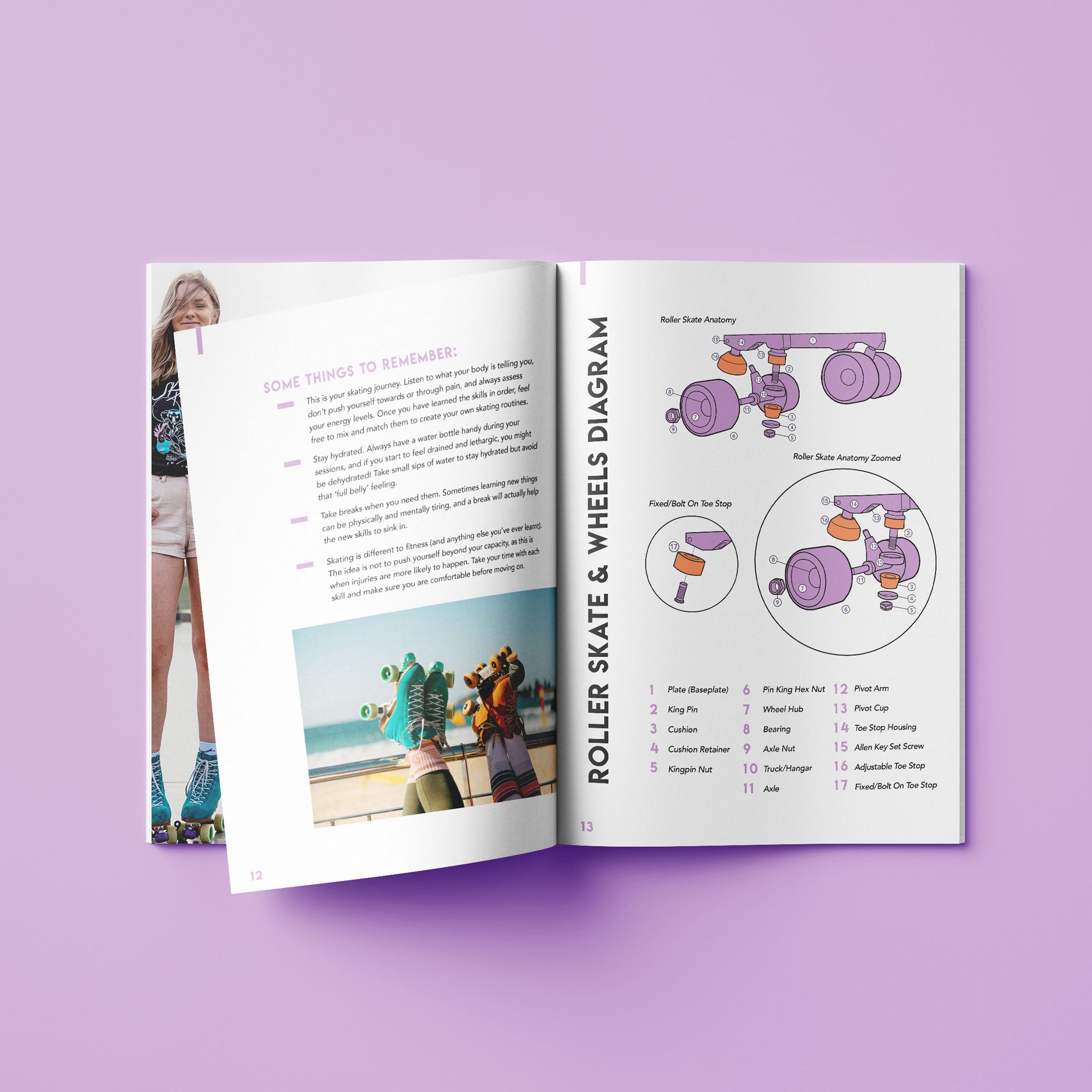
What is the anatomy of a roller skate truck?
Hanger – Refers to the main body of the truck into which the axles are inserted during manufacturing.
Axle – The axle is the part of the truck that holds your wheels. Axles can be different diameters requiring either 7mm or 8mm bearings for your wheels.
Axle nut – The axle nut secures your wheels onto the truck axle. Just like your bearings, the axle nut could be a 7mm or 8mm depending on your plate.
Pivot pin / arm – Pivot arms sit into the pivot cup in your plate to stabilise your trucks and assist with manoeuvrability. Most trucks have a fixed pivot arm which is part of the hanger. Some higher end trucks will have an adjustable pivot pin that screws into the trucks. An adjustable pivot pin helps to ensure the ball of the pivot arm is making good contact inside the pivot cup of your plates for maximum performance.
If you’d like to learn or brush up on the anatomy of your whole roller skate, head over to this blog for the full lowdown.
What kind of trucks are there?
Like most things in roller skating there is no universal truck. Brands have different trucks for different plate models. Trucks can be made of varied materials and come in a range of sizes depending on the type of skating your set up is for.
Good quality trucks are made of an alloy (metal). Most commonly, trucks are made of steel, but you can also get titanium trucks if you’ve splurged on a fancy plate or set up. Some more budget friendly skates may have a nylon (plastic) hanger with metal axles for their trucks.
Trucks also come in different widths. This is mostly a point of consideration for park skaters. Narrow trucks are what most skaters will be used to with their complete set ups or custom set ups. Most narrow trucks are around the same width with slight variations in some higher end plates that tend to be slightly narrower for increased agility. Wide trucks are enjoyed by some park and street skaters who want to increase the surface area for locking in grind tricks and add a wider base for stability with big bowl and vert skating. Wide trucks can be anywhere from 2-3”, with that measurement being the hanger portion that is used as the grindable surface (does not include axle length).
What does it mean to adjust your trucks?
When people mention that you need to adjust your trucks, what they are referring to is tightening or loosening the kingpin nut to increase or decrease the action of your skates.
When you apply pressure in your foot to turn or hit an edge, this pressure is sent down to your plate, then through the plate and pivot arm of your trucks this pressure is applied to the cushions that are nestled either side of the trucks. Your cushions then compress and expand accordingly as pressure is applied and released to generate momentum and allow your trucks and wheels to turn.
If your kingpin nut is loose, you will have lots of turning action from your skates as your cushions can compress and release as much as possible. If your kingpin nut is tight, then you are already applying pressure to your cushions and there is only so much they can compress and release, resulting in less movement. How you like to have your trucks set is a matter of personal preference and experimenting. It also comes down to the combination of your trucks and your cushions. You can learn all about cushions and their role in your roller skate set up here [https://shop.rollerfit.com.au/blogs/news/roller-skate-cushions-explained].
Troubleshooting your trucks
At some point in your roller skating journey it’s inevitable that you may encounter some issues with your skates that is truck related. Here’s some common problems and how to fix them.
Your skates won’t roll straight - Whilst this could be partly you applying a little bit of pressure to an edge that sends you in a particular direction, sometimes the problem is that our trucks are not evenly adjusted. The best thing to do is to tweak either the front or back kingpin nut with very small turns and roll your skate on a flat surface without your foot in the boots with each tweak until the skate rolls in a straight line.
Your trucks look wonky - Ensure that the trucks and all the parts around them are nestled properly into their housing places. If it’s still wonky it could just be that you need to adjust the kingpin nut a little to force the truck into place. If that doesn’t solve the problem, take your trucks off your skates and examine the axles and the section of the hanger that the cushions sit in. It’s possible to warp, bend and break these parts if they receive a lot of impact.
My kingpin nut is as tight as it will go but the truck is still loose - This is usually signals to a broken pivot cup. Pivot cups deteriorate over time and need replacing if they have cracks or sections missing. If the pivot cup is intact then you might want to consider opting for harder cushions.
That wraps up what you need to know about roller skate trucks. You can check out truck options over here. If you have any truck or skate related questions, shoot them our way. Our shop staff have years of experience and have tried and tested loads of products to give you the best advice.