


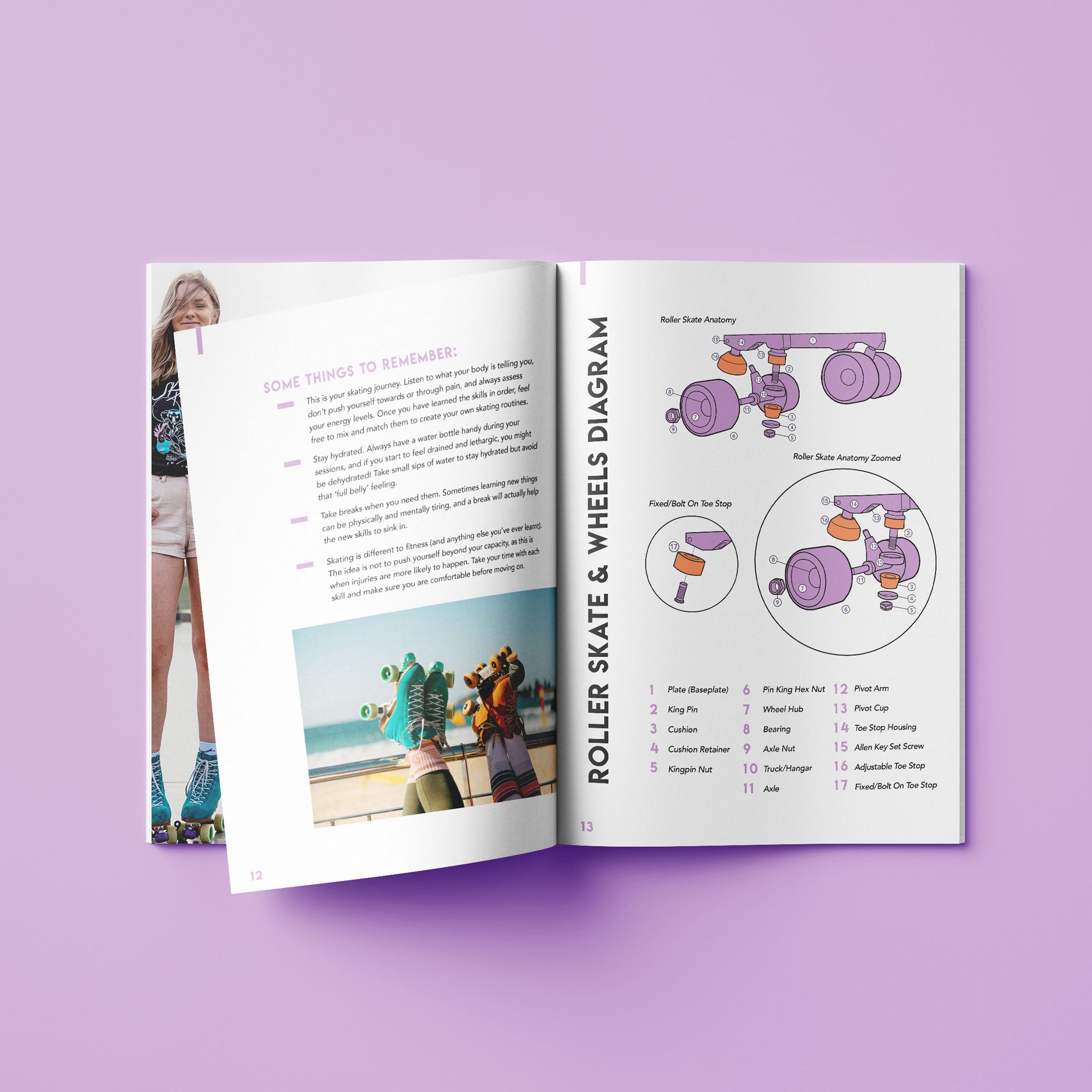

Roller Skate Anatomy 101
Are you new to roller skating or want to learn how to take care of your precious roller skates? Well, to do that you’re going to need to know about all the parts the come together in a roller skate build. Apologies for the long read, but there are a lot of parts to cover as we dive into roller skate anatomy!
All these skate parts need to be checked and cleaned over every once in a while to ensure your skates are in tip top shape. For most roller skates, all these components are replaceable should they deteriorate, break or if you’re wanting to experiment or upgrade. Just remember, not all skate parts are compatible with all other roller skate products, most of the time spare parts are brand and model specific.

Boots
Starting with the most obvious part, you’ve got your boots. They can have a heel or be a flat skate, this depends on personal preference and the skate style you’re using them for. They can be made of a variety of materials including vinyl, suede, leather, Clarino and come in different widths and stiffness levels. Your skate boots should fit nice and snug, think more like a second sock than a shoe.
Laces
Roller skate laces can be easily replaced so you can change up the look of your skates or replace them if they snap. Laces come in a variety of lengths and can be waxed or unwaxed. You can learn everything you need to know about roller skate laces here.
Plate
Plates are the part that connects your boots to your wheels. They can be made of different nylon (plastic) or alloy (metal) compositions and are the crucial part that translates all your bodies movements into your wheels. Different kinds of plates exist for different kinds of skating, and different size skates need different sized plates according to what plate mount your trying to achieve. So if you want to learn what plates do and the kind you need read this blog and follow that up with some more reading here about the kinds of mounts you can choose from.
Mounting bolts/nuts
To keep your plates and boots connected, mounting bolts go through the heel and toe areas of your boots. Your plate then slides onto the protruding bolts and is secured with a washer and nut. For some artistic roller skate boots, mounting bolts and nuts are replaced with mounting screws due to the different heel composition.
Kingpin
The kingpin holds all your cushions, cushion retainers and trucks on your roller skates. You have 2 kingpins on each skate. Kingpins can be angled at different degrees for different kinds of skating and purposes. Lower degree kingpins, the most common is 10 degrees, provide more stability. A kingpin with a higher degree, around 45 degrees, gives faster turning action with less effort.
Cushions
Cushions, also known as bushings, are integral skate parts that translate the shift in weight of the body to your trucks and wheels. Cushions come in different hardnesses and different shapes, each helping you to achieve different skate goals. We’ve got a blog breaking down everything you would want to know about cushions here.
Cushion Retainer
Sometimes referred to as cushion caps or bushing caps, these metal discs with a slight lip keep your cushions in place and help apply even pressure to the cushion as you skate and tighten/loosen your kingpin nut and trucks.
Kingpin Nut
The kingpin nut is the part that secures your cushion, cushion retainers and trucks in place on your plate. When people talk about tightening or loosening their trucks, they are referring adjusting the kingpin nut to reduce the amount of movement from the cushion/trucks by tightening the kingpin nut or increasing the amount of movement by loosening the nut. Some high performance plates will have a click action kingpin nut which helps for more precise and replicable adjustments.
Wheels
Roller skate wheels are made from a urethane composition. They come in a variety of sizes, widths and hardnesses for different skating purposes and styles. Go have a read of this blog where we break down all you need to know about roller skate wheels.
Bearings
Bearings sit inside the wheel hub and on the truck axle to make your wheels spin. Bearings are rated on the ABEC scale, and the internal race ring can be 7mm or 8mm in size to suit your truck axle. To learn everything you need to know about bearings, read this.
Trucks
Trucks hold your wheels and translate action from your plate to your cushions and wheels, allowing you to manoeuvre on your roller skates. Trucks can come in different widths for different kinds of skating. Standard or narrow trucks are for all kinds of roller skating. Wide trucks, being anything with a width of 2-3” is a choice for park and street skating to give extra stability and more surface area to execute grind tricks.
(Truck) Axle
The axle on your roller skates is the part of your trucks that holds your wheels. Axles can be two different sizes which corresponds to the size of bearings you need, 7mm or 8mm. Axles can also have varied lengths so just keep that in mind if you plan on using extra wide wheels. Sometimes, to ensure you have enough clearance of wheels from the cushions, you may need to put some washers on your axle so as to not inhibit your trucks from moving to their maximum degree.
Axle Nut
The axle nut secures your wheel into place on your axle. Axle nuts can be 7mm or 8mm in size to correspond to your truck axle. Ensure you tighten your axle nut just enough so your wheel is stable but can still spin freely, go too tight and you can damage your bearings. The thread inside the axle nut is lined with nylon to protect the fragile thread of the axle and reduce the effect of vibrations loosening the nut. Over time, this nylon coating will deteriorate, and you will need to replace the axle nuts.
Pivot Arm
The pivot arm helps to secure your trucks to your plate and apply pressure to your trucks and cushions so you can hit your edges and manoeuvre on your skates. Most skates have a fixed pivot arm, except for some high performance plates which have adjustable pivot arms to fine tune the fit of the pivot arm for increased responsiveness.
Pivot Cup
Pivot cups hold the pivot arm of your trucks in place. They can be made of different materials such as rubber, nylon, or Delrin. Pivot cups are generally a specific size and shape for each brand and model of plate, but some universal cushions can work for some models. Pivot cups will inevitably get cracks, holes and break with time. You must replace them, intact pivot cups are essential for a safe skating experience so be sure to check them if something about your skates feels a bit off.
Toe Stop Housing
The threaded section at the nose of your plate where you insert your toe stop or toe plug. For an adjustable toe stop plate, the threading of the housing can be Imperial (most roller skate plates) or Metric (Roll-Line plates). For a bolt-on toe stop plate, the toe stop housing is a smaller hole for the toe stop bolt, generally 5/16”.
Adjustable Toe Stop
An adjustable toe stop can be secured to the desired height on your plate. Toe stops come in varied sizes for different purposes. They are also available in long stem or short stem to account for different toe stop height preferences.
Toe Stop Nut & Washer
A hex nut in the right threading for the toe stop and a washer are used to secure an adjustable toe stop in place in the plate. The washer sits closest to the plate, and the nut is tightened against it.
Toe Stop Screw
Some plates use a screw on the nose of the plate to secure an adjustable toe stop or toe plug in place instead of a nut/washer combo. The screw can be loosened and tightened with an allen key. Tighten the screw just enough to secure the toe stop or plug.
Bolt On Toe Stop
A bolt-on toe stop is not adjustable. It is secured to the plate by a bolt that is inserted in the middle of the toe stop and into the toe stop housing at the nose of the plate. Not sure if you have an adjustable or bolt-on toe stop? Check out this blog to figure out what you have.
Toe / Jam Plug
Commonly used by rhythm, jam and roller dance skaters as a replacement for a bulky toe stop. A toe plug is smaller than a toe stop and can be made of different materials to make them more slippery, or grippy. The plug protects the plate and can be used for skills.
Slide/Grind Blocks
This is an optional extra for park and street skaters. A slide block uses a metal mounting bar that sits in between the kingpins of your plate and sits up against the plate. It is secured by the cushions, trucks and kingpin nut (the Brunny Hardcore Dragon Plate is an exception to this as it is secured straight to the plate). The slide block is used to slide along surfaces like coping, ledges and rails.
If you have any questions about any of the parts on your roller skates, how to maintain or upgrade them, send us a message. Our staff have been on wheels for decades and have seen it all!
If you’d like to learn more about roller skates and skate products, you can also explore what else is on the blog. We’ve written up our recommendations for a bunch of skate products and breakdown skate parts into more detail on the regular.